

Like every new parent you were probably bombarded with “helpful” advice from those experienced parents:
“Sleep when baby sleeps”
“Yes, poop is supposed to be that colour”
And
“Make sure you start an RESP”
That last one may not have been high on the initial priority list, but most diligent parents at least went into the bank and in their groggy, sleep-deprived state to get started. Many probably signed away their first born while smiling and nodding along with the bank employee as they said words like “Canada Education Savings Grant (CESG)” or “balanced portfolio”.
No matter what decisions you made at the beginning, your RESP should not be neglected. You can even move your RESP between institutions if you feel like you are not getting the benefits or are paying fees that are not aligned with your goals.
Knowing your RESP portfolio
The most important part of the RESP is to understand where you are in the timeline. You know that when your child turns 18 you will probably need to start making withdrawals – meaning you have an 18-year timeframe, and the time seems to tick away so quickly!
For this reason, I always recommend reviewing your RESP annually as its own separate portfolio, completely independent of your other savings and investments.
Have you thought about these three things??
1. Fees
Wouldn’t it be awesome if your RESP balance grew as quickly as your kids? Mutual fund fees, representing a charge of at least 2% of the portfolio, are like the tooth fairy giving $20 per tooth – until you do the math, you don’t realize that there are a lot of teeth (FYI that’s $400)! Reducing these fees should be the true number one priority because it is an aspect that you can control. Too many people settle for the product that they were “sold” at that initial bank meeting without looking closely at what it is costing them. Index funds or low-cost ETFs are the best alternatives.
PWL Capital did a study looking at the impact of fees specifically on RESP portfolios. Their assumptions start with the expectation that in today’s dollars an undergraduate student attending university and staying in residence would cost $68,000 over four years.
In a standard “balanced portfolio” with 60% in equities (like the pie chart above) they assessed three scenarios:
- No fees
With no fees and historical 20-year growth, the balanced portfolio would have grown to $76,000 – well above the amount required for university.
- Fees of 1.34%
Using a fee rate of 1.34%, which would be a standard indexed portfolio, or a robo-advisor account, the final balance would be $66,500. This is close to the amount required and would be sufficient for many families or could be subsized by part-time jobs or the parents contributing additional funds.
- Fees of 2.38%
Finally, at a fee rate of 2.38% which would be comparable to most mutual funds sold by any bank, the final balance was $60,000. At this high fee rate, the portfolio had an $8,000 deficit compared to what was required for university. In addition, the portfolio underperformed a portfolio with no fees by $16,000!
The moral of this story is that over 18 years, high mutual fund fees could eat up a significant chunk of your potential returns!
2. Risk
As your child gets closer to university age, the risk level of the RESP should change. However, most ‘balanced’ portfolios at the banks will have a standard mix of stocks (risky) and bonds/fixed income (safe) to try to cover all the bases.
The bank portfolio might look something like this for the whole life of the RESP:
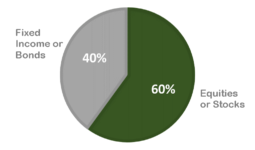
It’s to your advantage to start out the RESP by taking on a significant amount of risk and have the risk level change as your child ages. Depending on your risk tolerance, a more effective approach would be to start the portfolio quite risky, to maximize the returns while you still have time for the portfolio to recover in the event of a market crash. Then slowly add bonds to the portfolio to ensure that at least a portion of the cash in the RESP will be available when needed.
As an illustration:
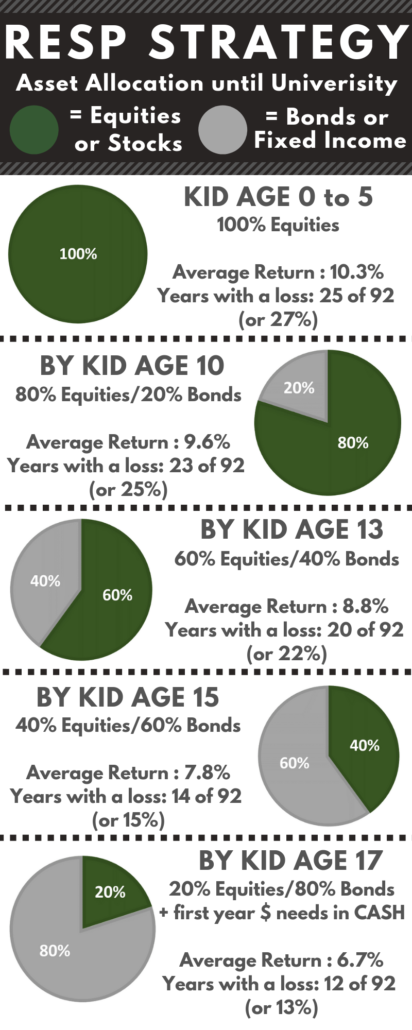
Note: the figures in the table are provided by Vanguard and represent only U.S. market data, before any fees.
What is being created here is a Target Date Education Fund. This can be accomplished on your own using self-directed investing to purchase ETFs of stocks and bonds. Another option is to use index funds bought through a bank to replicate these ratios. Or lastly, if you are an RBC or BMO customer you can purchase actual Target Date Education funds which accomplish this asset allocation without any work for you.
Well, wait, why wouldn’t I just buy a Target Date Fund?
If you fall into the category of ‘really-busy-often-forgetful-I’ll-deal-with-this-in-18-years’ type of person then a target date fund may be a great option for you. This convenience comes at a cost (naturally). The fees of these funds are high at just under 2% (averaging 1.7%) and also, the asset allocations are not in your control. The banks offer a much more conservative approach to the RESP which is safe, but will also traditionally provide lower returns over the long-term.
3. Contributions
Are you ready for a parenting hack? You know that money that the government sends you each month for having children? It used to be called the ‘baby bonus’, but now it’s the fancy Canada Child Benefit (makes you wonder when they will change the name of ‘Old Age Security’?)
If you can, what if you put all of that money into the RESP? So now, not only are you getting free money, but then you’re also increasing it by 20% because the government will match that contribution into an RESP (up to 20%). That’s a quick and dirty way to “find” RESP contributions even if you are feeling like it’s difficult to come up with money to contribute each month. I automate the contribution because I can approximate when it will be received and how much it will be. It takes all the thinking out of it for at least a year until I review the portfolio again.
Who knew RESPs could be so Complicated!?
The RESP is an amazing asset when you look at the tax-savings and also the free money provided by the CESG. Hopefully, when post-secondary education rolls around, your investment could be worth $50,000 or more! Protect your investment by considering the fees, risk level and contributions you are making and your children will thank you…maybe…someday.